 |
The History and the Mystery of John Cabot and the Cabot Rock |
Forget Christopher Columbus! Newfoundland has its own share of famous explorers and "firsts", when Chris was just a twinkle in his mother's eye!
First off were the Vikings, the real discoverers of North America around year 1000 (sorry Columbus). All visitors to Newfoundland should take the trip to L'Anse aux Meadows to see the Viking settlement there. The site is fascinating and well worth the trip up the "Viking Trail" (after you do the Baccalieu Trail, of course)!
And then there is John Cabot, or Giovanni Caboto as he was really called, having been Italian by birth. Cabot sailed for King Henry VII of England in 1497, 5 years after Columbus. And just where do you think he landed in his little ship, "The Matthew"? Grates Cove, Newfoundland of course! And like any good discoverer, he left his mark to prove it. (More about the Cabot Rock later).
Some people believe Cabot actually died in Grates Cove, and local townsfolk will tell you about an ancient earring and sword that were found, maybe belonging to him or his son Sancius. But before we give away the end of the story, let's start at the very beginning.
THE LIFE AND TIMES OF GIOVANNI CABOTO
It is believed Cabot was born in 1455 near Naples, but his name is most often associated with Genoa. He married a Venetian woman named Mattea, and some speculate that his ship "The Matthew" was named for her. Although this is an interesting coincidence, there is no evidence to suggest that the ship was built especially for Cabot. It seems more likely that the Matthew was just one of several ships involved in the Bristol trade, and happened to be the one available of the right size for the right price at the time of the adventure.
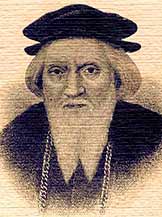
Cabot had 3 sons, Ludovico, Sebastiano (pictured right) and Sancio. Cabot went to Bristol, England around 1494, where he gained support for his ideas of sailing west across the north Atlantic from local merchants. Eventually, he caught the attention of the King, who on March 5, 1496 awarded Cabot and his sons letters patent, giving them:
"full and free authoritie, leave, and power, to sayle to all partes, countreys, and seas, of the East, of the West, and of the North, under our banners and ensignes, with five ships ... and as many mariners or men as they will have in saide ships, upon their own proper costes and charges, to seeke out, discover, and finde, whatsoever iles, countreyes, regions or provinces of the heathen and infidelles, whatsoever they bee, and in what part of the world soever they be, whiche before this time have beene unknowen to all Christians."
Cabot's First Voyage
1496 was his first trip, and a big failure. We know what happened through a letter dated 1497 by John Day, an English merchant. He states that Cabot went with one ship, ran into a disagreement with his crew, ran short of food and had bad weather, so decided to turn around. He was back in Bristol, it is reported, after only 15 days.
Cabot's Second Voyage
The second trip went better. Although Cabot had asked his backers for 5 ships this time, he received only one, "The Matthew". It was a navicula, a small vessel, with 3 masts and able to carry 50 tons of cargo. With 18 crewmen (including possibly his sons), he left Bristol in May of 1497. About one month later, reportedly June 24, 1497 (St. John's day), he landed on the east coast of North America, but it is not known exactly where. Many historians believe it was Newfoundland, while others say Cape Breton, Labrador, or even as far south as Maine.
Vague details can be pieced together by several known writings in his time, but there is no first hand account left by Cabot himself. It is said that Cabot and his men went ashore, put up a cross and planted the banners of England and Venice, thus claiming the land for King Henry VII. They met no one, but saw signs of inhabitants, perhaps Beothuk indians.
One such writing, a letter from Raimondo de Soncino to the Duke of Milan, dated December 18, 1497, speaking of "The Admiral", Zoanne (Giovanni/John) Caboto, said that Cabot told him that the sea was full of fish, which were not only taken with a net, but by a basket that was lowered into the water with a stone. The Admiral felt that the fish was so plentiful, the Kingdom would no longer need Iceland as a trader of "stock-fish" (cod). What else could this describe, but Newfoundland and its codfish?
The first map that records Cabot's discoveries is that of Juan de la Cosa published in 1500. It is thought to be a compilation of his voyages in 1497 and 1498, from which he presumably did not return. The coastline runs east to west, with english
flags marking certain named places. Speculation abounds as to where this coastline is actually located, one possible scenario being the south coast of Newfoundland, which does indeed run generally east to west. This would certainly discourage the idea that Grates Cove is where Cabot landed, as it is on the east coast on the Avalon peninsula. However, others speculate this could represent coastline of the Avalon, or St. Lawrence River, or Nova Scotia, or numerous other places, as there is no clear clues to grab ahold of. Each Discovery theorist will be able to interpret the map to suit their own purposes, and make very compelling arguments. So this writer will shamelessly do the same!....
From the documentary evidence, we learn that there was an island nearby where Cabot made his landfall. On the de la Cosa map, there is indeed an island just off the point of the "English coastline" . It is barely seen on the right of the map pictured here. It is labeled "Y. Verde", or in english, "Green Island". Anyone who has seen Baccalieu Island will agree immediately that it is a very green island indeed, and perhaps not coincidentally, the closest point nearby is called "Bay de Verde". From the book by Williamson, it is recorded that a scientific review of the original map by Guillen cites the first name on the eastern point of the coast as "C. Grago", the "C" probably meaning "Cavo" or in english, "Cape". The meaning of the word "Grago" is unknown. One can see that it is not entirely dissimilar to the word "Grates", or one of its presumed origins, "Gratos". And Grates Cove is most certainly at the head of the Conception/Trinity Bay peninsula.
More evidence is the map of the world made in 1507 by Johannes Ruysch. This is the second oldest map showing Cabot's discovery. There is evidence by the publisher of the map that suggests Ruysch actually accompanied Cabot on his 1497 voyage, and hence he drew the map from first-hand experience. On Ruysch's map, he shows "Terra Nova" or "New Land". He lists only 5 names, one being "IN. BACCALAURUS". The word "IN" is short for "Insula", or "Island". Depending on the scale, this might indicate the entire island of Newfoundland itself, or perhaps it represents Baccalieu Island, at the tip of Conception Bay near Grates Cove. The island is nestled in a horseshoe shaped bay, which is very much like Conception Bay. The name "Baccalieu", therefore, is one of the first recorded and longest-lived names associated with Canada. It is likely this place was an important one to Ruysch, being 1 of only 5 places named on his map. Why else would Baccalieu Island be featured so prominently on this map, and every map of the time thereafter, had it not great importance to the explorers?
Another interesting coincidence is that writings of the time suggest Cabot promised to name an island for a couple of his companions on the trip. There are only 3 known names of the passengers, one of whom was Giovanni Antonio de Carbonariis, a Milanese cleric. It is known that Cabot spent some 30 days traveling around the coast of the land he discovered. Is it possible that he fulfilled his promise to his friend, and that is how Carbonear Island, up the Conception Bay shore, got its name?
Of the historians who believe the landfall was in Newfoundland, the debate is, where exactly? Many people support the idea it was Cape Bonavista, because it is due west of Dursey Head in Ireland, where Cabot is reported to have left the mainland on his voyage, and because it is recorded as "the land first seen by Cabot" on a map made by Mason in 1617. Visitors to the Discovery Trail can see a replica of The Matthew moored there today. While these people may be right, the good folks of Grates Cove challenge this notion quite strenuously because of the Cabot Rock. Furthermore, "Land First Seen" does not necessarily mean "Land First Set Foot On"! Bonavista is the headland immediately across the bay from Grates Cove. It is quite possible that Cabot first saw Bonavista, but continued southerly to the next point, landing at Grates Cove, near to Baccalieu Island. The people of Cape Breton in Nova Scotia will dispute the landfall too for many reasons, including a notation on a world map made by Sebastian Cabot (Giovanni's son) in 1549 that shows the landfall made by his father in a place that looks like Cape Breton. The controversy continues!
Cabot's Third and Final Voyage
The King was very pleased with Cabot upon his return, and granted a pension to him of £ 20 per year. In February 1498, King Henry granted Cabot his second letters patent, authorizing him to take 6 ships back to "the londe and iles of late founde by the seid John". In May 1498, John left with 5 ships, and 1 returned to Ireland after being damaged in a storm, but Cabot was never heard from again. Someone did indeed collect his pension on his behalf until 1499, but it is unclear if Cabot ever returned. Local legend has it that Giovanni Caboto and his son Sancio were killed near Grates Cove on his final voyage , which is tied into the legend of the Cabot Rock. While people assume that Cabot was lost with his ship the Matthew, there is strong evidence to suggest this is not the case. The name of the ship Cabot sailed in is only recorded for the 1497 voyage. There is no reason to conclude when he sailed in 1498 he used the same ship. In fact, one would expect more people and provisions were sent the second time, and with presumably more money to back him after the first success, he likely took a larger ship. In fact, the Bristol records show a ship named "Matthew" in trade to various ports for several years after 1500, and it is very likely Cabot's first ship. So, while it is possible that Cabot was indeed shipwrecked and perished on his second journey, the Matthew is likely not at the bottom of the sea off the Grates Rock!
The Legend of the Cabot Rock
While Bonavista would like to lay claim to Cabot having made landfall there, no other place has as good a claim as Grates Cove to having been visited at some point by Cabot, and may perhaps be the final resting place for the man himself.
Local residents will tell you about the Cabot Rock, first mentioned in historical writings in 1822 by William Epps Cormack in his journal which recorded his trek across Newfoundland in search of Beothuk Indians :
"The Point of Grates is the part of North America first discovered by Europeans. Sebastian Cabot landed here in 1497, and took possession of "The Newfoundland". He recorded the event by cutting an inscription, still perfectly legible, on a large block of rock that stands on the shore".
(Cormack, like many people, confused Sebastian Cabot, the son of John and an explorer in his own right, as the one who made the trip in 1497). Cormack unfortunately doesn't say what the inscription said, but we learn this from Leo E.F. English, curator of the Newfoundland Museum, when he took pictures of the Rock in 1927. He claimed the rock showed the words:
IO CABOTO :: SANCIUS :: SAINMALIA
along with parts of other names. "IO", is the Italian word for "I ", therefore simply "I, Cabot", or possibly is short form for "Giovanni", and "SANCIUS" is Latin for his son's name, "Sancio". It is unclear what "SAINMALIA" means, except some speculate it is a reference to "Santa Maria". English believed that the Rock was evidence carved by Cabot himself, or a member of his crew, that he had visited that spot, and perhaps might even commemorate the place as his landfall. Others speculate that it might be an inscription by the crew to mark where Cabot and his son Sancio died. But one thing seems clear; Cabot visited the place in either 1497 or 1498, or both! Most documentary evidence about Cabot's voyages was not discovered until the mid to late 1800's, and the most detailed and illuminating evidence, the John Day letter, was not discovered until the 1950's. It stands to reason that William Cormack, who saw the rock in 1822 and recorded its link to Cabot probably had little interest or understanding of the history surrounding Cabot, and would have no reason to lie about it. It seems most likely that he was just reporting what he saw, and of course the rock would have been much more legible 190 years ago. The evidence of Cormack is very compelling. Mr. English, might have had his own biases, but when examining his 1927 photograph, it clearly says SOMETHING on it, which does not appear to be in english. One would have to wonder how and why words that could be spanish, portuguese or italian would be on a stone in Grates Cove, which was predominantly settled by the English and Irish in the late 1700's. Yes, there certainly were fishermen of these "romance language" countries in the area dating back to the 1500's, but when you add Cormack's 1822 assertion that the rock said "Cabot" and that it commemorated his landfall, one has to consider this quite seriously.
The Evidence from Gaspar & Miguel Corte Real of Portugal
There is further evidence to support the notion that Cabot died in Newfoundland, if not Grates Cove itself. This comes through another famous explorer, Gaspar Corte Real of Portugal, who visited Newfoundland shortly after Cabot, in the year 1500. Although Real, like Cabot, did not return from his trip, two of his ships did return, bringing with them 57 natives (perhaps Beothuks) which had been captured and were to be sold as slaves to finance the trip. One of these, a boy, was wearing a pair of silver earrings of Venetian origin, and a broken Italian gilt sword was also found in their possession. This fact was reported in 1501 in a letter by Pietro Pasqualigo, Venetian Ambassador at the Court of Portugal, who wrote an account of the Corte Real voyage, just 11 days after it returned. In the letter he says:
"The language they speak is not understood by anyone, though every possible tongue has been tried with them. In this country, there is no iron, but they make swords of a kind of stone, and point their arrows with the same material. There has been brought hence a piece of a broken sword, inlaid with gold, which we can pronounce undoubtedly to have been made in Italy; and one of the children had in his ears two pieces of silver, which as certainly appear to have been made in Venice, a circumstance which induces me to believe that their country belongs to the continent, since it is evident, that, if it had been an island where any vessel had touched before this time, we should have heard of it."
What Pasqualigo obviously did not know was that Cabot had reached these shores just 3 years earlier. These artifacts could have come from none other than Cabot, as no one else had travelled to North America in the two years between Cabot's and Real's voyages. Plus, Cabot was a Venetian, and from Italy, which is the origin of the earrings and sword. As Cabot only landed once on his trip in 1497, and says he did not meet any inhabitants, it is not possible they were left behind on that journey. So, it seems very clear that the artifacts were gained by the natives during Cabot's trip in 1498, from which he did not return. It is not clear exactly where Real's crew took these natives captive, but it is known that he generally travelled from Labrador and down along the eastern Coast of Newfoundland. It is conceivable that this happened near Grates Cove.
Interestingly, after Gaspar's disappearance, his brother Miguel, also an explorer, went looking for him in 1502. He too went missing and was never seen again. However, there was an amazing discovery in 1918 in Massachusetts. A large rock which had previously been submerged in Dighton, became visible above the water line. On it were numerous strange markings. It was determined by some scholars who studied it to contain the Portuguese coat of arms, and an inscription dated 1511 saying "Miguel Cortereal, by the will of God here chief among the indians". It is very interesting that another explorer possibly left his mark upon a rock to tell others of his fate, sounding eerily familiar to the Cabot Rock in Grates Cove!
The Disappearance of the Cabot Rock
By now you may be very intrigued by all of this, and would like to see the Cabot Rock for yourself. Well, unfortunately that can't happen, because legend has it that someone stole it! The year is not clear, but residents report that "some time in the late fifties or early sixties ", two men in a media van showed up one day and chiselled part of the rock containing the inscription away. It has never been heard of since! (See the photo near the top, taken by Vicky Martin of Grates Cove. This is what is left, you can see the missing piece near the top. Look closely, and you can see writing near the middle of the rock. In comparing to Leo English's photo taken in 1929, this is the remnants of the word 'MALIA'.
This writer has compared the photo of 1929 to the present day rock, and has to admit some skepticism about the story. There is no doubt that the event took place as recounted by the local fishermen who witnessed the "robbery". It seems likely that the people DID take away some piece chiselled from the rock, but likely from a corner or the very centre near the middle crack seen there today. There is no appreciable difference, however, in the two photos in the important middle face of the rock, where the inscription is reported to have been written. So, even if something was taken away, it was not the inscription itself as local legend has it. Sadly, it is much more likely that over time the inscription has just slowly faded away, helped along by the saltwater spray and fish offal that spilled onto it for years from the nearby fishing stage sitting over top of it.
So today, when you visit Grates Cove, you will see a memorial in a spot near where the Cabot Rock is located, but not the Cabot inscription itself. How frustrating is that?! It is a perilous climb down to see the rock itself, which is still standing large on its flat shelf by the waterline. But on close examination of the front, very little can be seen today. On the sides, however, other interesting dates and initials can be seen, dating back to the late 1600's.
Unfortunately, all we have to go by now is the writings of historians, and the memories of the local citizens of Grates Cove to attest to the existence of the inscription on the Rock, and to claim that John Cabot did in fact visit the place.
While the Inscription is gone, the legend lives on, and when you visit Grates Cove, you will get a definite feeling about the possibilities it holds. On a foggy day, you can almost see the ghostly shape of The Matthew in our sheltered cove, and imagine Cabot and his crew walking the grassy hillsides.





